Low-Code Platform Infographic for Public Health Departments - SSG, LLC

A low-code platform enables health departments to build, customize, and deploy applications using visual development tools with minimal coding. By utilizing pre-built templates, drag-and-drop components, and automated workflows, low-code platforms help public health agencies modernize systems more quickly, adapt to changing program needs, and improve operational efficiency.
- Rapid Development and Deployment: With drag‑and‑drop interfaces and pre‑built modules, teams can quickly design workflows, dashboards, and reporting tools without waiting for traditional development cycles. This enables departments to respond more quickly to emerging health crises or policy changes, improving agility and service delivery.
- Cost Efficiency: By reducing the need for specialized coding expertise, low‑code platforms effectively lower development and maintenance costs, making digital transformation for public health agencies more sustainable.
- Scalability and Flexibility: Whether a department is managing a small local initiative or scaling up to statewide programs, applications can be easily adapted and expanded. This built-in flexibility allows teams to adjust workflows, integrate new data sources, and add functionality without rebuilding systems from scratch.
- Enhanced Data Management and Reporting: Low‑code platforms simplify data integration across multiple systems, enabling departments to consolidate information into a single source of truth. This enhanced visibility informs decision-making while allowing leaders to evaluate program effectiveness.
Key Takeaways
- Low-code platforms enable public health departments to build and deploy applications faster by reducing reliance on traditional development cycles.
- Improved integration, scalability, and data management help public health teams streamline workflows and reduce operational complexity.
- Adopting a low-code platform supports more efficient service delivery by allowing agencies to respond quickly to changing public health needs.
Benefits of Low-Code Application Platforms for Public Health Departments
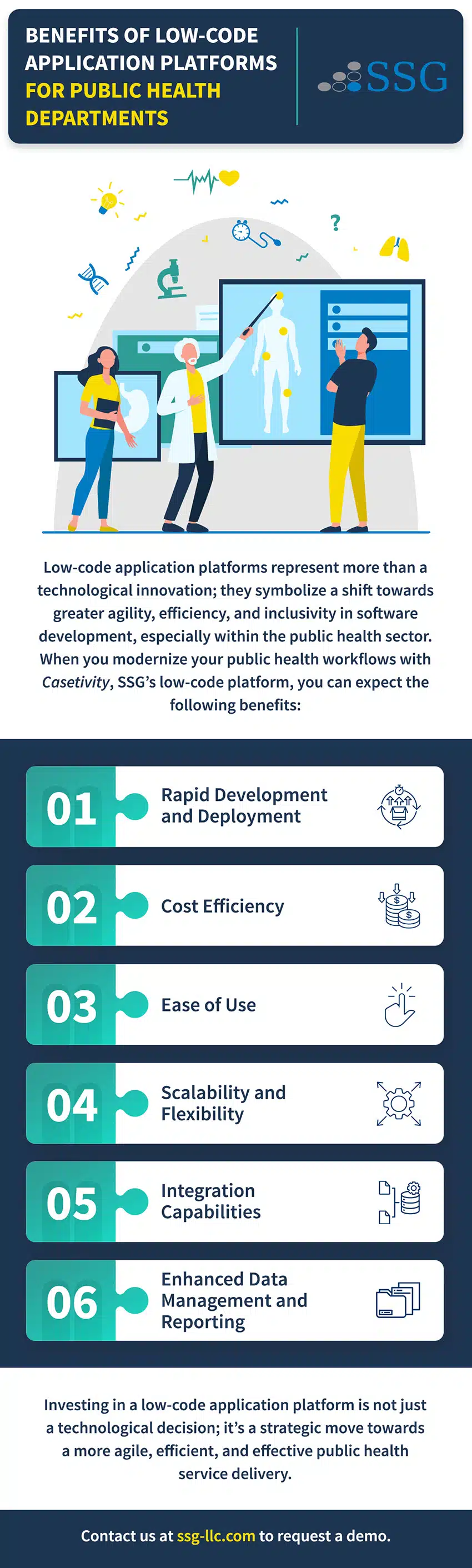
Low-code application platforms represent more than a technological innovation; they symbolize a shift towards greater agility, efficiency, and inclusivity in software development, especially within the public health sector. When you modernize your public health workflows with Casetivity, SSG’s low-code platform, you can expect the following benefits:
- Rapid Development and Deployment
- Cost Efficiency
- Ease of Use
- Scalability and Flexibility
- Integration Capabilities
- Enhanced Data Management and Reporting
Investing in a low-code application platform is not just a technological decision; it’s a strategic move towards a more agile, efficient, and effective public health service delivery.
Contact us at ssg-llc.com to request a demo.
By enabling faster application development and greater flexibility, low-code platforms help public health agencies modernize workflows while supporting evolving operational and reporting needs.
FAQs
- What is a low-code platform in public health?
A low-code platform is a software development environment that allows public health organizations to build and customize applications with minimal coding. This approach helps agencies deliver new solutions more quickly while reducing the complexity of traditional software development.
- How do low-code platforms improve public health workflows?
Low-code platforms improve public health workflows by automating repetitive processes, simplifying application updates, and making it easier to integrate data from multiple systems. This enables agencies to respond more efficiently to changing program requirements and operational needs.
- What are the benefits of low-code application platforms?
Low-code application platforms accelerate development, reduce costs, improve scalability, and simplify data management. These benefits help public health organizations modernize legacy systems while delivering applications that better support their programs and users.